
Science
The real science as basis for the story.
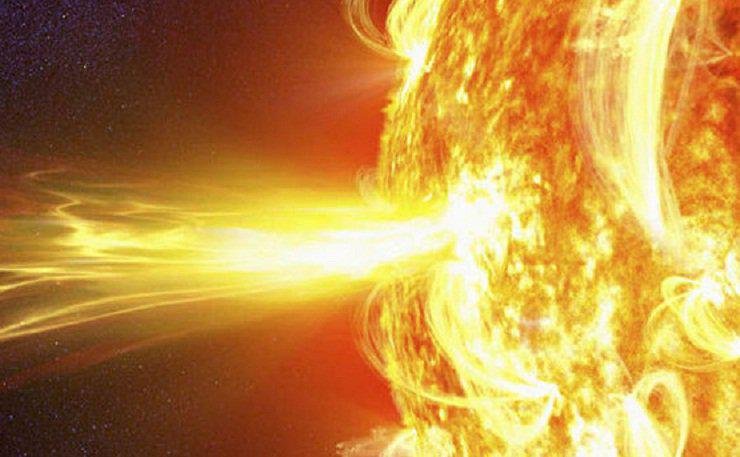
Coronal mass ejections (CMEs) are essentially giant explosions of superheated gas (plasma) off of the Sun’s surface, driven by magnetic instabilities, launching highly charged plasma out into space. A ‘Halo’ CME is one that is launched in the direction of the Earth. These halo CMEs can cause intense geomagnetic storms on Earth potentially devastating our most vulnerable infrastructure such as are our power grids, satellite networks & GPS, and undersea internet cables. This is caused by the highly efficient transfer of energy from the solar wind into our planet’s surrounding space environment, generating Geomagnetically Induced Currents (GICs), which flow through long, conductive materials on Earth's surface.
On September 1st 1859, an intense CME hit the Earth 17 hours after exploding from the Sun. It caused bright aurora’s as far south as the Caribbean. The surge of electricity in the atmosphere overloaded and short-circuited telegraph wires all over the world. This is known as “The Carrington Event.” Some experts predict that if the same level event happened today, it would take society 10 to 15 years for our electrical grids and communication systems to fully recover.
In 2026, as Solar Cycle 25 reaches its maximum, our critical infrastructure systems are highly vulnerable to CMEs. Agencies like the NOAA Space Weather Prediction Center, the NASA Heliophysics division, and the European Space Agency are actively monitoring solar activity. While initial detection (15 to 18 hours) tells us a CME is coming, we cannot know its true danger (magnetic orientation) until it reaches satellites at Lagrange Point 1 (L1), located 1 million miles from Earth. This is the only point where scientists can confirm if the CME's magnetic field is "southward-pointing" (Bz negative), which is required to trigger a severe geomagnetic storm. Once the DSCOVR or ACE satellites at L1 detect the solar wind's shock front, Earth has only 15 to 60 minutes before impact.